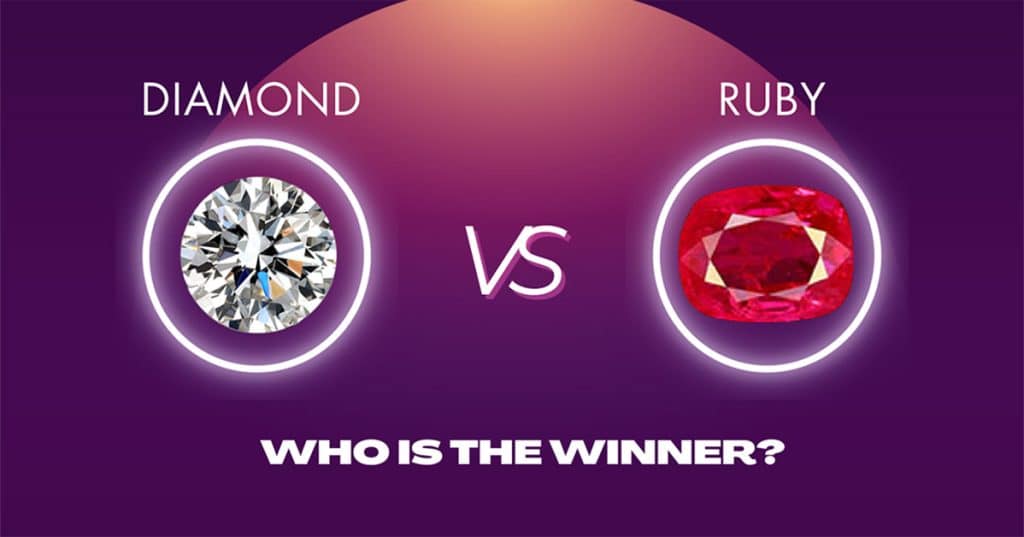
Is ruby cheaper than a diamond?
At commercial quality, yes. At fine quality, not anymore.
That second half is new. Three years ago a well cut 1 carat diamond in the range most buyers choose cost more than a comparable top color unheated ruby. Today it costs roughly half as much, while the ruby has risen. Full figures further down this page.
What has not changed is that carat weight tells you very little about a ruby’s price, and a great deal about a diamond’s. Diamonds are graded to a global standard. Rubies are not. Two rubies of the same weight can differ in price many times over depending on color, origin, and treatment.
Here are the six factors that decide it.
What Decides Whether a Ruby or a Diamond Costs More
1. Rarity
The gem, whether a diamond or ruby can command a higher price depending on how rare it is and how difficult it is to source it. Diamonds are found more abundantly as compared to Rubies. The scarcity of rubies (especially over 1-carat weight) can definitely drive up the price of the ruby.
Exceptions: Colored Diamonds are very rare and can be sold at very high prices.
You can find “100 D Flawless” Diamonds, but it is very difficult to find 10 perfectly matched Rubies.
2. Quality
The price of both Diamonds and Rubies can be influenced by their quality.
For diamonds, the 4 C’s, Carat weight, Clarity, Cut, and Color all play a role to determine its value.
When it comes to Rubies we look at six factors which we call 4C’s + OT. The most important are Color, Origin, and Treatment which determine its price.
3. Origin
The price of diamonds is not based on where it is mined. Although origin can be determined based on information provided to testing institutes of the rough stones before cutting and polishing, this is just to help with where the diamond was sourced from and to know whether it has been mined responsibly and it generally does not affect the price but it may appeal to your personal sensibilities.
On the contrary, the price of rubies is most certainly dependent on their origin. Rubies sourced from Burma are considered the finest in the world and command the highest prices. Mozambique has become the most important commercial source of fine ruby and produces excellent top color material at more reasonable prices, which is why it is the origin used in the comparison below. Thailand, Madagascar, and Vietnam also produce high quality rubies below that again.
4. Treatments
Both diamonds and rubies can be treated to improve their color and clarity. These treatments bring down the price of the gemstone.
Natural gemstones without any treatment or negligible treatments command a higher price than treated gemstones.
If the gemstone has color or clarity-enhancing treatments, reputable gem labs like GIA, GRS etc will mention that they are treated.
If you want to know more about treatments on rubies you can read our Ruby Treatment Guide. For current ruby pricing by size, see how much a one carat ruby costs.
And to know more about treatments on diamonds, you can read this article on the GIA website.
5. Certificate
Today most people selling or buying a diamond or a ruby rely on a good certificate from a reputable gem lab to determine its price.
The certificate builds trust and focuses on the above-discussed factors to determine the quality of the gemstone and its origin which lays the foundation to subsequently ascertain the asking price and buying price.
6. Demand and supply
In 1888, the pricing of diamonds was being controlled by big corporations like De Beers who held the monopoly of the world’s diamond supply that therefore resulted in them controlling diamond prices.
With time that has changed and now diamond prices, although not fixed, follow a set standard based on grading as discussed above and guidelines set by online global marketplaces like RapNet that help moderate prices creating more transparency for sourcing and selling diamonds.
The demand and supply of diamonds directly influence the price of diamonds as well.
On the contrary, Rubies do not have a standardized pricing as they are rare and the price is based on what the seller wants to price the gemstone at, over and above the above-mentioned factors.
Diamond prices move regularly, and since most diamonds are not rare, resale usually comes in below the purchase price. The last three years have made that plainer than usual: lab-grown material took share at the retail end and natural diamond prices at consumer qualities fell sharply, as the table below shows. What has not changed is that price transparency makes a diamond easy to sell.
A top grade unheated ruby behaves differently, because supply cannot be increased to meet demand. That is not a guarantee of appreciation, but fine ruby has not faced the same pressure.
Ruby vs Diamond Price Comparison at 1 Carat and 3 Carat
For this comparison, I have decided to compare diamonds and rubies which most consumers consider buying (This is my opinion based on my 20 years of experience).
Generally, consumers prefer the middle range color or clarity range for diamonds, which are I-color, VS1-clarity range, and top make grade which we call ‘Triple Excellent.’ So these diamonds are white, clean, and sparkly enough for the average consumer.
For rubies, Mozambique origin currently is easier to source and a lot more reasonably priced than the Burma equivalent. So, for this comparison, I have focused on Top ‘Vivid Red,’ Unheated, well-cut Oval shape, Mozambique Rubies.
I have also included top ‘investment’ grade Burma rubies which are exceptionally difficult to source and almost impossible to find. The price for these rubies is very subjective as just finding ‘two’ to compare is impossible. Anyway, I have provided some price estimates below.
Illustrative prices as of July 2026.
| 1 Carat Ruby vs 1 Carat Diamond | 3 Carat Ruby vs 3 Carat Diamond | ||
| US$4,000 to US$6,500 for the Mozambique Ruby price |  | US$45,000 to US$48,000 for the Mozambique Ruby price |  |
| US$2,500 to US$3,000 for Diamond Price |  | US$35,000 for a diamond |  |
| US$20,000 for Burma Ruby |  | US$300,000 or more for Burma Ruby |  |
So, is ruby cheaper than a diamond? At commercial quality, yes. At fine quality, no longer.
Three years ago a 1 carat diamond in this range sold for around US$5,000 to US$5,500 and a comparable Mozambique ruby for US$3,000 to US$3,500. Today the diamond figure has roughly halved and the ruby figure has risen by more than half. The two lines have crossed.
The reason is supply. Top color unheated ruby above 1 carat cannot be produced to order, and no amount of demand changes that. Natural diamond at the qualities most consumers buy has faced three years of falling prices as lab-grown material took share at the retail end.
The practical lesson: carat weight tells you very little about a ruby’s price. Color, origin, and treatment do. On the figures above, two 1 carat rubies of top color differ by three to five times depending on origin alone.
For more prices on ‘different’ diamond sizes and quality, I do recommend checking our previous blog post here: https://www.buygemstone.info/how-much-does-it-cost-to-buy-a-0-50-carat-or-1-carat-or-2-carat-diamond-ring-in-bangkok-thailand/
Also, if you would like to contact us or have any questions feel free to email us at sales@thainativegems.com
Frequently Asked Questions
Are rubies more expensive than diamonds?
At commercial quality, no. At fine quality, now yes. A heated, commercial grade ruby still costs far less per carat than a comparable diamond. At the top of the market the comparison has reversed in the last three years: a top vivid red unheated ruby now outprices a well cut diamond of the same size, and an unheated Burmese stone costs several times more again.
Are rubies rarer than diamonds?
Yes. Gem quality ruby is considerably rarer in the ground than gem quality diamond, particularly in larger sizes and in untreated form. Diamonds have historically been more expensive on average because the market for them is far larger and more standardized, not because they are harder to find.
Are rubies worth more than diamonds?
It depends entirely on quality, origin, and treatment. Two rubies of the same carat weight can differ in price many times over. Diamonds are graded to a global standard, so pricing is predictable. Ruby pricing is not, which is why an experienced eye matters far more when buying one.
What makes one ruby more valuable than another?
Color first, then clarity, cut, and carat weight. After that, two factors that do not apply to diamonds: whether the stone has been heated or treated, and where it was mined. An unheated stone commands a significant premium over an aggressively heated or treated stone of identical appearance, and a certified Burmese origin adds further value.
Why are Burmese rubies more expensive?
Origin affects ruby pricing in a way it never affects diamond pricing. Burma (Myanmar) has produced the finest red rubies on record, and a laboratory report confirming Burmese origin can multiply the price several times over. On the figures in the comparison above, a 1 carat Burmese stone runs three to four times a comparable Mozambique ruby, and at 3 carat the gap is wider still.
Is a 1 carat ruby more expensive than a 1 carat diamond?
At fine quality, yes, as of July 2026. A top vivid red unheated Mozambique ruby of 1 carat now runs roughly twice the price of a well cut 1 carat diamond in the color and clarity range most buyers choose. An unheated Burmese ruby of the same weight costs several times more again. At commercial quality the answer is still no. This is a reversal from three years ago, when the diamond was the more expensive of the two.
Should I buy a ruby or a diamond for an engagement ring?
Both work. Ruby is 9 on the Mohs scale, second only to diamond, and hard enough for daily wear. Choose ruby if you want color and rarity, diamond if you want brilliance and easier resale. Ruby’s value holds well over time precisely because supply cannot be increased at will. One caution on treatment rather than hardness: a lead-glass filled ruby can be damaged by ordinary jewelry repair and routine cleaning, so it is the wrong choice for a ring worn every day.
Do rubies hold their value?
Fine untreated and normally heat-treated rubies have held their value well, for the same reason that applies to any natural stone: supply is finite. Between 2023 and 2026 the fine ruby figures in the comparison above rose while the diamond figures fell. Aggressively treated stones, such as flux-filled, lead-glass filled, or diffusion-treated rubies, and commercial quality material do not hold value in the same way, and should not be bought as an investment.
How can I tell if a ruby is natural or synthetic?
Not reliably by eye. Both have the same chemical composition and the same hardness, 9 on the Mohs scale. Synthetic rubies have been produced since the early 1900s and can look identical to natural stones. The inclusions differ under magnification, and a report from a recognized laboratory is the only dependable confirmation for a stone of any real value.
Thai Native Gems Gemstone Search & Custom Engagement Ring service (Best way to buy gemstones in Bangkok):
If you are in the market looking for the best gemstone and custom handmade engagement ring – Contact Us – and let us know what your budget is and what you are looking for.
From this initial information, we will swiftly find and email you gemstone options available in the market right now. Unlike other traditional or online dealers, I am not looking to sell you anything. We will provide you honest, frank, and objective opinion on what we think is best in the budget you offer.
This service is free, and there is absolutely no commitment to buy any of our suggestions. The only thing you have to do is not respond to our email and you won’t hear from us again! So, you truly have nothing to lose!
How do we compile this gemstone list? Our search process is provided below:
1) We first will contact our local gemstone supply network and check if there are any stones that fit your requirement in Bangkok. We have over 50 contacts in Bangkok and will check ALL to make sure we can provide you with the best deal.
2) If not satisfied, we will then check online through our extensive global network sifting though we usually do this in last resort as we prefer seeing the gemstone in person to make sure the color is accurate and as described.
What type of engagement rings can you make and how are they made?
1) We usually set our engagement rings in 18k yellow or white gold or 950 platinum settings. Our rings are all hand-crafted and made by highly skilled Thai craftsmen.
Examples in some of the rings we made you can see on our YouTube channel and are shown below:
YouTube Channel PLAY LIST

_____________
Contact us today to get all your wholesale gemstones, diamonds and jewelry needs. We can Source, Search and Supply anything you require.
What will you get if you contact us
- Start a conversation with us at FB.com/ThaiNativeGems/.
- Get wholesale and highly competitive prices of gemstones & diamonds from anywhere through our extensive network of contacts around the world.
- Every stone we sell is checked in house by a GIA Graduate Gemologist, or comes with an independent laboratory certificate.
- We provide personalized service and NOT the same old “One Size Fits All” Approach.
You can learn more by clicking here.
This was very helpful but im still not a gemist… so I am still in the air about the worth of my ruby earrings…. I’m gonna look at some earrings on y his sight and go from there. I appreciate all of your info provided⁹.