A client of mine bought a beautiful yellow sapphire from us. GIA certified 11.16 carats, natural, unheated (no indication of heat treatment), perfect vivid yellow color with the full story on paper. A premium stone by any standard, which I paid a premium price for as well.
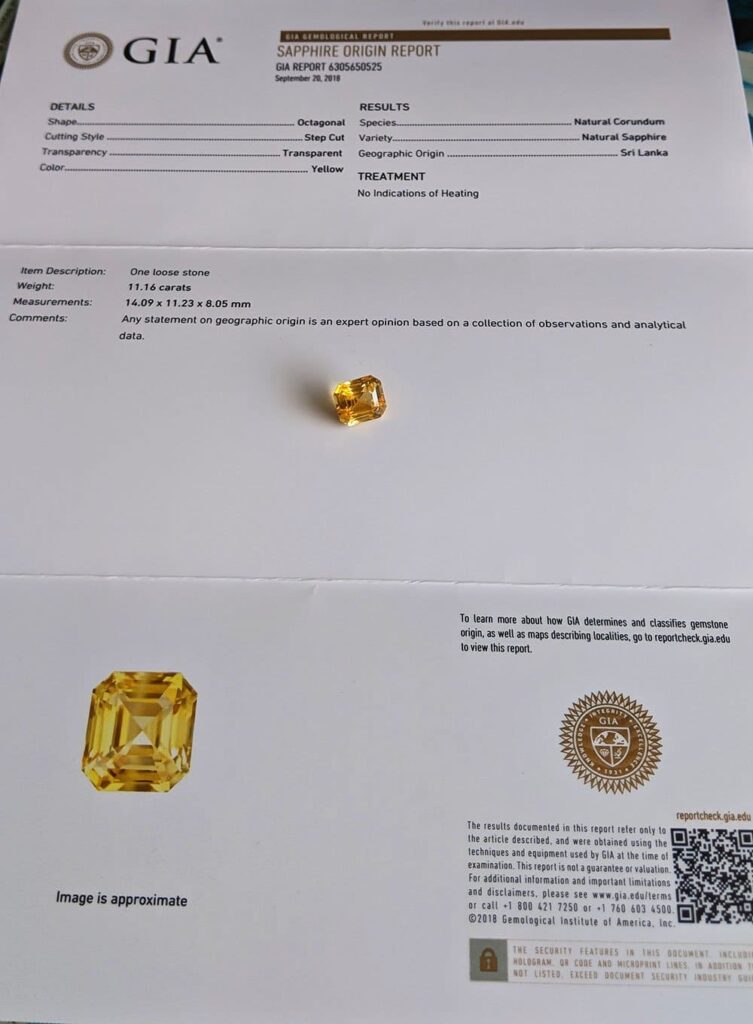
He bought it for Vedic astrological purposes. Yellow sapphire is the stone of Jupiter (Guru), and he believed it, based on his astrological chart, would bring him good fortune. By his own account, it did after purchasing it. He wore it, loved it, and eventually decided he wanted to add a blue sapphire alongside the yellow in the same piece. A simple enough request, especially already wearing it over a year with no issues.
He went back to his jeweller, who had set the initial yellow sapphire with no issue. The jeweller began work on the new setting, adding the blue sapphire link (as shown in the image below) and torched the yellow sapphire pendant directly. He did not remove the yellow sapphire first.
Within seconds, the yellow sapphire turned completely white.

The jeweller’s immediate conclusion? The stone must be irradiated. A treated stone, as no natural yellow sapphire can turn white this way. Not what the client was sold. He told the client exactly that.
The client called me straight away. He has been a friend for over 15 years and knows my reputation well enough to ask questions first rather than draw conclusions. But he was genuinely confused and worried. The jeweller had told him the stone must be irradiated, and he needed to understand what had actually happened.
I did not have an immediate answer. I had not seen this before. But I knew the stone was genuine. I had sourced it myself directly from a supplier I had dealt with multiple times. So I started researching more about natural yellow sapphires.
I reached out to Jeffrey Bergman, one of the most respected colored stone dealers and educators in the trade, who is also based in Bangkok. He has also been a friend of mine for over 20 years. He was familiar with the issue immediately and advised me to try restoring the color using short-wave ultraviolet light.

That conversation also led me to a 1987 study published in Gems and Gemology by researchers Kurt Nassau and G. Kay Valente, a GIA publication. They had examined over 150 yellow sapphire samples and documented exactly this behavior. Certain natural, unheated yellow sapphires have a color that responds to heat and light in ways that iron-based stones do not. The science was there. It had been there for decades. Nobody had just thought to tell buyers or jewellers about it.
I tested the stone under short-wave ultraviolet light and the color came back. Fully restored, exactly as it was the day he bought it.
No damage. No fraud. No irradiation. The GIA study explained everything.
I am writing this post because that research changed how I understand yellow sapphire, and every buyer deserves to know what I had to go and find out the hard way.


The Problem Nobody Talks About
There is a widespread belief in the gem market that works like this:
- Heated = treated = lower value
- Unheated = natural = stable = safe
For blue sapphires and rubies, this is broadly true. Unheated stones are rarer, more valuable, and the color in an unheated stone is exactly what nature produced.
Yellow sapphire does not follow the same rules. And the consequences of assuming it does can be expensive and alarming, and can hurt everyone dealing with it due to a lack of knowledge.
There Are Actually Seven Types of Yellow Sapphire
In a landmark 1987 Gems and Gemology study, researchers Kurt Nassau and G. Kay Valente examined over 150 yellow sapphire samples and identified seven distinct types, each with a different color origin and a completely different reaction to light, heat, and irradiation.
This is not obscure science. It was published by the GIA. But it rarely makes it into the conversation when a stone is being sold.
Here is what matters for buyers:
Type 1: Natural, Unheated – Color Center (typically Sri Lanka)

Color comes from what scientists call a color center in the crystal structure of the sapphire. To understand why this matters, it helps to know a little about how that color is actually created.
Sapphire is essentially aluminium oxide (corundum). In a perfect crystal, it would be completely colorless. Color appears when something disturbs that perfection, either a trace element like iron or chromium, or a structural defect in the crystal lattice itself. In Type 1 yellow sapphire, the color comes from the second kind: a structural defect, specifically a trapped electron or hole at a point in the crystal where an atom is missing or displaced. This defect absorbs certain wavelengths of light and allows others to pass through, producing the yellow color we see.
The critical word here is “trapped.” The electron or hole is held in place by the energy structure of the crystal, but that hold is not unconditional. Heat provides enough energy to knock it loose. When the crystal is heated, even to relatively low temperatures, the trapped state is disrupted, the color center collapses, and the stone loses its color. This is why my client’s yellow sapphire turned white when the jeweller applied heat with a torch.
What makes Type 1 behavior so unusual is that the process is reversible. Light, particularly ultraviolet light, carries enough energy to push electrons back into the trap and re-form the color center. This is why exposure to sunlight over a few days, or short-wave UV in a more controlled setting, can fully restore the color. The stone has not been damaged. The color center has simply been switched off and then switched back on.
This is also why Type 1 yellow sapphires as mined may sometimes appear darker or lighter than their stable state. Deep in the earth they may have been exposed to natural irradiation from surrounding rocks, creating additional color, or to geothermal heat, which would have partially faded it. Gem dealers dealing in yellow sapphires have known for generations to leave yellow sapphires in sunlight after purchase to establish their true stable color before selling them, even if they could not explain the physics behind it.
Under normal conditions of wear, a Type 1 stone is perfectly stable. The problem arises only when the stone is exposed to concentrated heat, as from a jeweller’s torch, or in some cases prolonged exposure to strong halogen lighting. For everyday wear, including in fine jewellery, a Type 1 yellow sapphire is a beautiful and reliable stone. The key is knowing what it is, and making sure anyone who works on the jewellery knows it too.
I can offer my own experience as evidence of this. The stone my client bought had been sitting in my safe since 2017. He purchased it in 2024, seven years later. The color was exactly as it should be. No fading, no shift, no deterioration of any kind. Darkness and stable room temperature are perfectly safe for a Type 1 stone. The issue is not storage, it is heat and, in some cases, intense, sustained light.
Type 2: Irradiated – Fading Color Center
This is the one to genuinely avoid. Color is induced by irradiation of a colorless sapphire. It looks vivid in a dealer’s parcel. But it will fade in sunlight, in a display case, on your finger near a window. The color can be restored by re-irradiating the stone, but it will fade again. This is not a stable gemstone for fine jewellery.
Type 3: Natural, Unheated – Iron-Based Color (Thailand, Australia, Tanzania, and some Sri Lankan)
Color is caused by iron in the crystal. Not heated. And unlike Type 1, completely stable to light and heat. This is the unheated yellow sapphire that deserves its premium without reservation.
Type 4: Natural, Heated
Paler iron-containing material that has been heated to develop stronger color. The color is stable. A properly heat-treated yellow sapphire is a reliable, wearable gemstone.
Type 5: Diffusion Treated – Titanium and Beryllium
This is where it gets more complicated, because not all diffusion treatments are the same. The original form of diffusion treatment used titanium, which produced a very thin color layer just under the surface of the stone. That thin zone is stable to light, but it is so shallow that recutting or repolishing can remove the color entirely. This must always be disclosed.
Then, from around 2002, a far more significant treatment emerged from Thailand: beryllium diffusion. Beryllium is an extremely small atom and diffuses into the corundum crystal at very high temperatures, in some cases penetrating deep into the stone and in some cases coloring it completely throughout. This is a fundamentally different situation from titanium diffusion. A beryllium-diffused yellow sapphire can appear, on the surface, identical to a natural-color stone, because the color is not confined to a thin surface layer but distributed through the entire gem.
The color produced by beryllium diffusion is stable. It does not fade with light or ordinary heat in the way that Type 1 or Type 2 material does. But it is a laboratory-induced treatment, and it has serious implications for value. A beryllium-diffused yellow sapphire is worth a fraction of a natural-color stone of the same appearance. The only reliable way to confirm beryllium diffusion is through advanced chemical testing, specifically secondary ion mass spectrometry (SIMS) or LA-ICP-MS, both of which are laboratory procedures. Standard gemological testing will not always catch it.
This is why, for any significant yellow sapphire purchase, a certificate from a reputable laboratory such as GIA, Gubelin, or SSEF is essential. The certificate must specify not just treatment status but the nature of any treatment, and for high-value stones the laboratory should have conducted chemical analysis, not just visual examination. A certificate that says only “no indications of heating” does not rule out beryllium diffusion, since beryllium diffusion is conducted at very high heat but may leave few visible inclusions if the stone was carefully processed.
Type 6: Synthetic – Stable Color
Laboratory-grown sapphire with nickel or other elements added to produce yellow color. Color is stable to light. Must be disclosed and priced as synthetic.
Type 7: Synthetic – Irradiated, Fading
Synthetic sapphire with color induced by irradiation. Fades in light, just like Type 2 natural irradiated material. Must be clearly disclosed and priced accordingly.
What Happens at Gem Shows and Why It Matters
Here is something I have observed over many years in the gem trade.
At gem shows, experienced dealers who sell yellow sapphires are very careful about their lighting. You will rarely see unheated yellow sapphires displayed directly under strong halogen spotlights, the kind that generate serious heat and intense light.
Ask most of those dealers why, and they cannot give you the scientific explanation. But they know from experience that yellow sapphires behave differently under strong light. They have seen stones shift color in the parcel. So they protect their inventory without fully understanding the mechanism behind it.
That instinct is correct. What they are observing is exactly what Nassau and Valente documented in 1987. Type 1 unheated stones have a color that responds to heat and light in ways that iron-based stones do not. Strong halogen lighting, which produces both intense light and heat, can temporarily shift the color of a Type 1 stone.
The dealers who know this protect their stones. The buyers who don’t know this buy blind.
“Unheated” on a Certificate Is Not the Full Story
A GIA certificate that states “no indications of heating” tells you something important. But it does not tell you the color origin. It does not tell you whether you have a Type 1 color-center stone or a Type 3 iron-based stone. And those two unheated stones behave completely differently.
Before buying any yellow sapphire, ask:
- Is this natural or synthetic?
- Has it been heated or irradiated?
- What is the color origin, iron-based or color center?
- Is the certificate from a reputable lab such as GIA, Gubelin, SSEF, GRS, etc.?
And if you are having the stone set, tell your jeweller to remove it before applying any heat. Every time. No exceptions.
The Candle Test Dealers Have Used for Decades
Long before laboratory certificates existed, experienced gem dealers globally used a simple field test: hold the stone briefly in a candle flame, or leave it on a sunny windowsill for a few days.
A stone that fades is likely irradiated (Type 2) or a Type 1 with a reversible color response. A stone that holds its color is almost certainly iron-based and genuinely stable.
This is not a replacement for laboratory testing. But it is a fast, practical indication of what you are dealing with.
What Happened to My Client’s Stone
To close the story where I opened it: the stone was a genuine, natural, unheated yellow sapphire. GIA certified. Nothing about it was fraudulent or inferior.
It had already been set and worn without any issue. The problem came when the jeweller torched the pendant without removing the yellow sapphire, then wrongly told my client the stone must be irradiated.
I did not have an immediate answer. I reached out to Jeffrey Bergman, consulted the research, and that led me to the 1987 GIA study by Nassau and Valente, the same one quoted throughout this post, which documented exactly this behavior in Type 1 unheated yellow sapphires. Following Jeffrey’s advice, I tested the stone under short-wave UV light and the color was fully restored.
The stone is the same stone it always was. But I learned something that day that changed how I talk to every client who buys a yellow sapphire from me, and to inform them of the type of sapphire they will be purchasing from us.
I always believe education and learning through experience will always lead us and our trade to a better position in understanding the natural stones we are dealing with.
Now you know it too, before it happens to you and not after.
A Note for Vedic Astrology Buyers
A significant number of people who buy yellow sapphire do so for Vedic astrological reasons. In Jyotish, yellow sapphire is the gemstone of Jupiter, known as Guru or Brihaspati. It is prescribed to strengthen Jupiter in the birth chart and is associated with wisdom, prosperity, good fortune, and spiritual growth. It is one of the Navaratna, the nine sacred stones of Vedic tradition.
If you are buying a yellow sapphire for astrological purposes, the stakes around color stability are even higher. The stone is meant to be worn continuously, often against the skin, and the integrity of its color is considered important to its effectiveness.
This makes the question of color origin especially relevant. A Type 1 unheated Sri Lanka stone is a natural, untreated gemstone with a strong astrological pedigree. But as this article explains, it can behave unpredictably under heat. A Type 3 iron-based stone is equally natural and unheated, and its color is completely stable under any normal conditions of wear.
For astrological buyers, my recommendation is always to seek a certificate that specifies not just treatment status but color origin. And regardless of the type, make sure the stone is removed from its setting before any jewellery repair work is carried out.
My client wore his yellow sapphire through everything. By his own account, it brought him exactly what he hoped for. The color scare during the jewellery repair was alarming, but the stone itself was never in doubt. It came back exactly as it was. Some things, it seems, are more resilient than they look.
The Bottom Line
Unheated does not always mean stable. Heated does not always mean inferior. And a certificate, on its own, does not tell you the full story.
Yellow sapphire is one of the most beautiful and undervalued gemstones in the world. Buy it with open eyes, know the type, know the color origin, and make sure your jeweller knows what they are working with before they pick up a torch.
Tarun Gupta is a GIA Graduate Gemologist and Managing Director of Thai Native Gems (1960) Co., Ltd., Bangkok. For over 25 years he has sourced and supplied yellow sapphires to clients worldwide. For questions about specific stones or certification, visit thainativegems.com.
Contact us today to get all your wholesale gemstones, diamonds and jewelry needs. We can Source, Search and Supply anything you require.
What will you get if you contact us
- Start a conversation with us at FB.com/ThaiNativeGems/.
- Get wholesale and highly competitive prices of gemstones & diamonds from anywhere through our extensive network of contacts around the world.
- Every stone we sell is checked in house by a GIA Graduate Gemologist, or comes with an independent laboratory certificate.
- We provide personalized service and NOT the same old “One Size Fits All” Approach.
You can learn more by clicking here.