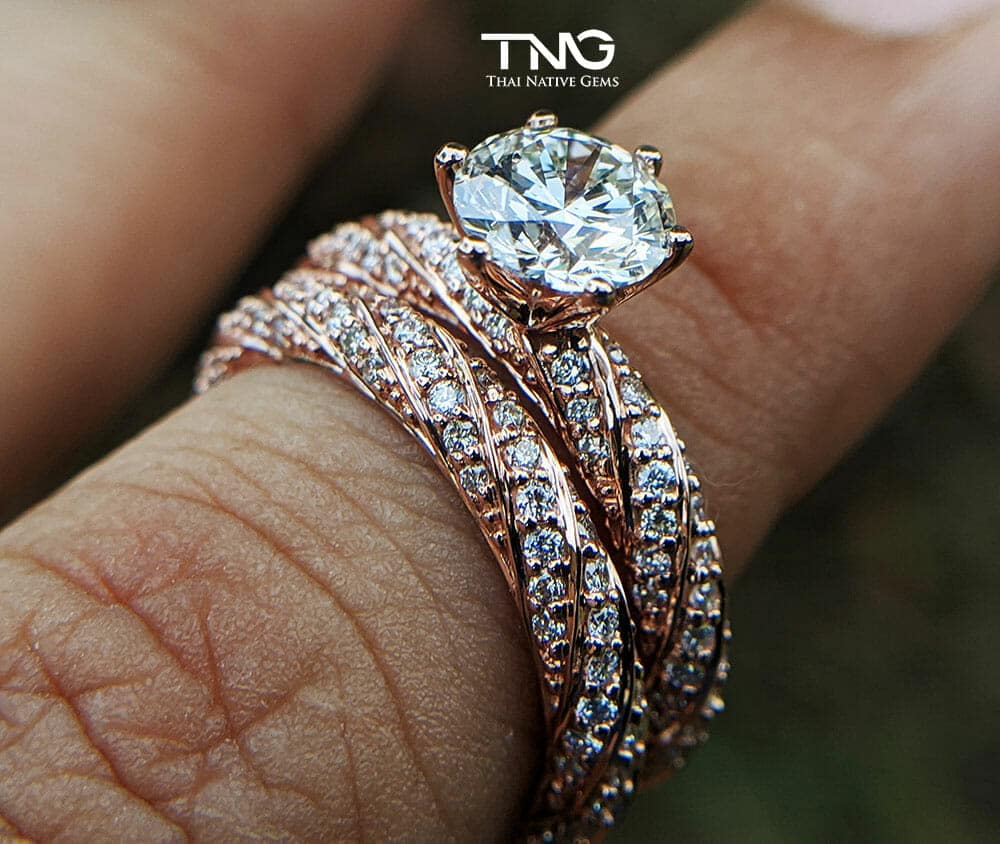
Search “engagement rings in Bangkok” and you run straight into two walls. The first is the travel forums, where thread after thread warns about scams, swapped stones, fake certificates, and “gem tours” that end in regret. The second is the storefronts, every one of them promising the best diamond, the best price, and the best service. So who is actually telling you the truth?
I’m a GIA Graduate Gemologist, and my family has been in the Thai gem and jewelry trade since 1959. I’ve spent decades on every side of this business: sourcing stones, grading them, and helping buyers from Europe, the US and Australia navigate a city that’s almost impossible to read from the outside.
Here is the honest version, with nothing to sell you. Bangkok is a genuinely good place to have an engagement ring made, but for reasons most websites get completely wrong. This guide separates the myths from the facts, and shows you exactly how to buy without getting burned.
Is It Cheaper to Buy an Engagement Ring in Bangkok?
Let’s deal with the biggest myth first. Is a diamond cheaper in Bangkok than in London, New York, or Sydney?
Simple answer: no. Thailand doesn’t mine diamonds, it isn’t a major diamond-cutting center, and it isn’t a global diamond trading hub. A diamond’s price is set internationally by the 4Cs (carat, color, clarity, and cut), and those numbers don’t shrink because you’ve crossed a border. If a diamond looks unusually cheap here, it’s almost always because something on that list has quietly been compromised.
There’s also a cost most buyers never see coming: Thailand charges 7% VAT on diamonds. On a US$30,000 stone, that’s an extra US$2,100, gone before you’ve paid for the setting. (Treat that as an illustrative figure, not a live quote. Contact me for current pricing.)
So where does Bangkok actually save you money? In the making, not the stone. Thailand has a deep bench of genuinely world-class craftsmen, and skilled bench labor here costs a fraction of what it does in the West. A handmade or fully custom setting that would be expensive back home is meaningfully more affordable here, and that’s a real, defensible saving. The center stone, though? That’s a global commodity. Anyone promising you a “Bangkok discount” on the diamond itself is selling you a story.
Choosing the Center Stone: The 4Cs That Actually Matter
The center diamond is the single largest cost in almost any engagement ring, so this is where a little knowledge protects the most money. Understanding the 4Cs lets you ask sharper questions and spot where a “bargain” is really a compromise.
Color. Diamonds are graded from D (completely colorless) down to Z (light yellow). Colorless stones (D to F) are the most valuable, but the best value usually sits in the G to I range. Stones here still look white to the eye, especially once set, at a noticeably lower price.

Clarity. This grades internal and external flaws, from Internally Flawless (IF) down to Included (I3). The value sweet spot is VVS2 to VS2. Inclusions in this range are difficult to see even under 10x magnification, so you’re paying for appearance, not a flawless certificate you can’t see anyway. Where the inclusions sit matters too: a flaw under the table (the flat top facet) affects price more than one near the edge.
Cut. This is the one never to compromise on, because cut is what makes a diamond sparkle. A round brilliant is the most popular shape for good reason. Insist on a minimum cut grade of “Very Good,” ideally “Excellent.” On a GIA report, the top combination of cut, symmetry and polish is known as “Triple Excellent.”
Carat. Simply the diamond’s weight, and therefore its size. Price climbs steeply at the “magic” weights (0.50, 1.00, 2.00 carat) because demand clusters there. A stone at 0.90 or 1.90 carat can cost meaningfully less than one a fraction larger, while looking nearly identical on the hand.
One more factor worth knowing: fluorescence. Diamonds with medium to strong fluorescence often sell at a discount, yet in most cases it has no visible effect on the stone. For many buyers, that’s a quiet way to get more diamond for the money.
Natural or Lab-Grown? The 2026 Reality
This question barely existed a few years ago. Today it’s one of the first every couple asks, and for good reason. Lab-grown diamonds now make up the majority of engagement rings sold in the United States, with The Knot’s 2026 study putting them at 61% of center stones, up dramatically since 2020.
A lab-grown diamond is chemically, physically and optically identical to a mined one. To the eye, and even under a loupe, they look the same. The difference is price: lab-grown stones cost a fraction of natural ones, and those prices have fallen sharply as production has scaled.
The trade-off is value retention. Because more lab-grown diamonds can always be made, they hold almost no resale value, while natural diamonds keep more of their worth and their rarity. Neither choice is “right.” Lab-grown wins if you want the biggest, brightest stone for your budget; natural wins if rarity, legacy, and long-term value matter to you. (I’ve covered this in depth in my full guide to lab-grown diamonds.)

Whichever you choose, the certification rule still applies: a natural stone should carry a GIA or HRD report, and a lab-grown stone an IGI or GIA report, with a laser inscription on the girdle you can verify.
Your Three Options: Retail, Online, or Custom
There are really only three ways to buy an engagement ring in Bangkok, and the right one depends mostly on how much time you have.
Retail store. If you want to try rings on and walk out with one the same day, a store is your fastest route, whether that’s a branded boutique like Tiffany or Cartier, or one of the many jewelers across Bangkok’s malls. You’ll pay full retail, and the center stone in particular will carry a retail markup.
Online. Plenty of international retailers will ship a finished ring to Thailand or to your home. Convenient, but you’re buying sight-unseen and trusting the seller’s grading, so certification and return policy matter more than ever.
Custom. If you have a little time and want something genuinely unique, a custom ring made in Bangkok is where the city’s craftsmen earn their reputation. You choose the stone, the metal and the design, and you pay for the setting at local labor rates rather than a brand’s retail markup. This is the option that actually plays to Bangkok’s strengths.
Where to Buy in Bangkok, and How to Vet Them
Bangkok does have reliable dealers; you simply have to find them. The long-established names tend to cluster in the same places: Silom Road and Suriwong, the malls (Emporium, Central, Paragon), MBK, and Chinatown (Yaowarat). Dealers who have operated from the same location for many years have a reputation to protect, and it isn’t worth scamming you over a single sale.
But “established” is not the same as “trustworthy,” and a long lease doesn’t certify a diamond. Wherever you shop, use common sense, negotiate, shop around, and ask the four questions below before you hand over a single baht.
How to Buy Safely: 4 Questions That Separate Honest Jewelers From the Rest
You don’t need to be a gemologist to protect yourself. You need four questions. Ask any dealer or jeweler in Bangkok these, and their answers will tell you almost everything you need to know.
1. Is the center diamond certified by a reputable third-party lab?
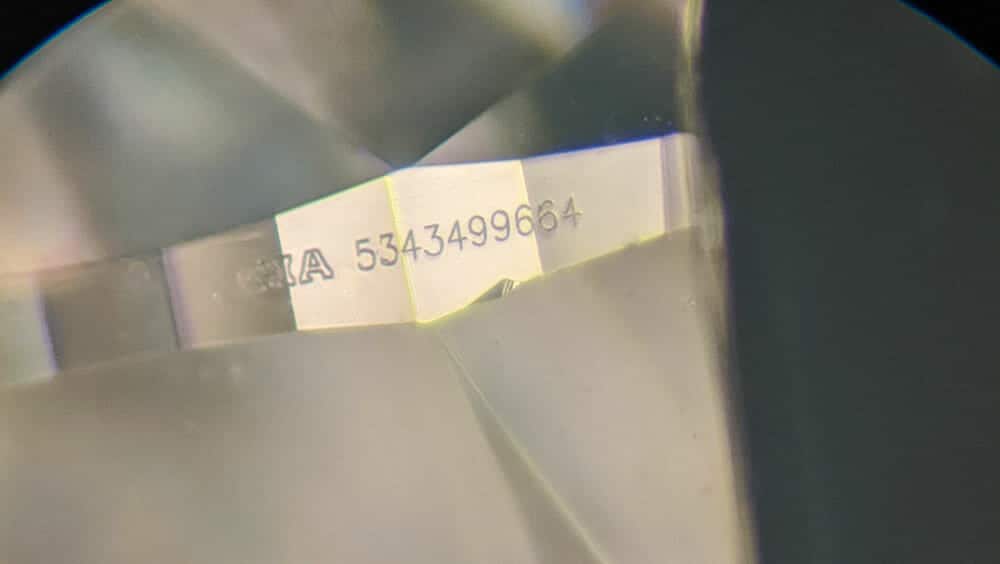
The only answer you want is yes, and the lab should be GIA or HRD (or IGI if you’re buying a lab-grown stone). If the diamond has no independent certificate, or it’s “certified” by a lab you’ve never heard of, walk away. An uncertified center diamond is a leap of faith you don’t need to take.
2. How can I verify the diamond matches its certificate, and what happens if it doesn’t?
A confident seller will show you the diamond’s laser inscription on the girdle and let you match its inclusions to the certificate under a loupe or microscope. The second half matters just as much: if the stone later turns out not to match the paperwork, will they refund a returned ring in full? “All sales final, no matter what” is a red flag. “Yes, if we misrepresented it, you get your money back” is the answer of someone who stands behind what they sell.
3. What metal is the ring set in?
Acceptable answers are 18k yellow or white gold, or platinum. If someone tells you the ring is set in 24k or “100% pure” gold, walk away. Pure gold is far too soft to hold a diamond securely, and the stone would work itself loose. That answer means the seller either doesn’t understand their own product, or is counting on you not to.
4. Do you have an in-house Graduate Gemologist?
The ideal answer is yes: it means someone on site can actually verify every stone they sell. “No, but we have decades of experience” can still be fine if the first three answers were solid. But a dealer who can neither certify a stone nor explain how they check it is not where your engagement ring should come from.
These four questions work anywhere in the world, not just Bangkok. Ask them early and ask them directly, then watch how the person reacts. A jeweler worth your trust will welcome them. The ones who get defensive have just answered a fifth question you didn’t even need to ask.
Check the Price Before You Buy
The single best protection against overpaying is knowing the global price before you negotiate. Because diamonds are a globally traded commodity, you can establish a fair market range online in an afternoon.
Reputable online retailers such as Blue Nile, James Allen and Brilliant Earth let you filter by the exact 4Cs you’re considering, and comparison tools like Rare Carat and PriceScope aggregate listings so you can see the going rate side by side. You’re not necessarily buying from them. You’re learning what your specifications should cost, so that any Bangkok quote can be judged against a real number rather than a salesperson’s promise.
When you compare, look beyond headline price to cut, symmetry, polish, the type and location of inclusions, and fluorescence. Also factor in the extras on an international purchase: shipping, insurance, your own country’s import duties, and Thailand’s 7% VAT. (For real-world figures, see my breakdown of what a 0.50, 1, or 2 carat diamond ring costs in Bangkok.)
The Buying Process, Step by Step
Once you know what you want, the process itself is straightforward:
- Set a timeframe. Decide when you actually need the ring. A real deadline prevents last-minute, regretted purchases, and tells you whether there’s time for a custom piece.
- Set your budget. Knowing your number first narrows every other decision that follows.
- Educate yourself. Learn the 4Cs (and the 5Cs if you’re considering a colored gemstone) so you can ask the right questions and avoid buyer’s regret.
- Explore your options. Retail, online, or custom: pick the route that fits your timeframe.
- Do your due diligence. Check reviews and credentials, compare, and never let yourself be rushed. A good jeweler will answer every question without pressure.
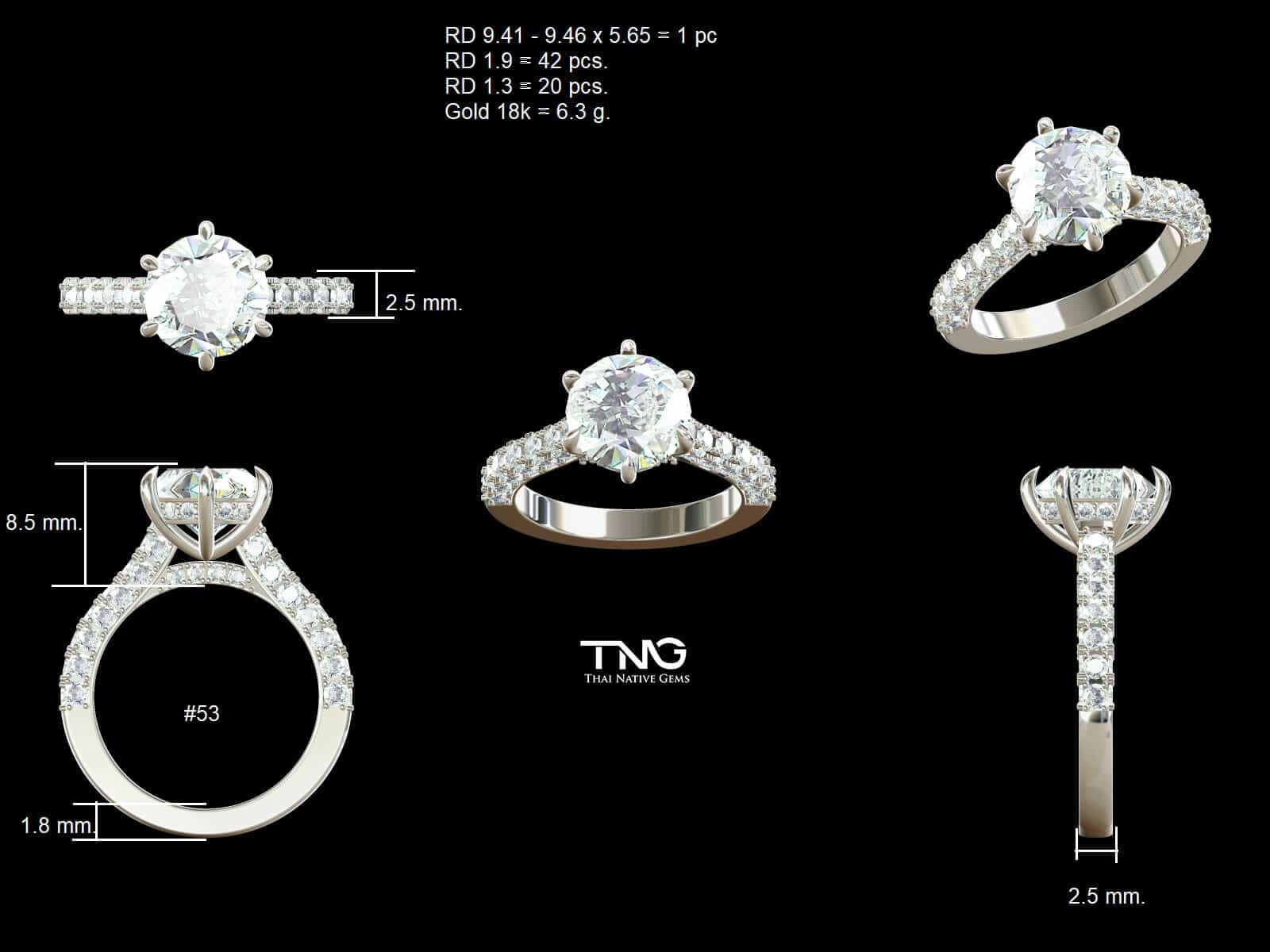
- Communicate clearly. Especially for a custom ring: agree the stone, metal, design, CAD drawing, approximate final cost, and delivery date in writing before work begins.
- Sort shipping and delivery. Confirm insured shipping, and be aware of customs and import duties in your destination country.
- Celebrate. You’ve done the work, now enjoy the moment.
Shipping Your Ring Home
If your ring is traveling (across Thailand or overseas), agree the shipping arrangements up front. Make sure the jeweler insures it against loss, damage and theft in transit, and check whether your own country charges import duty on its arrival.
When the ring reaches you, inspect it carefully and check the size in case it needs adjusting. Confirm you’ve received all the paperwork: the invoice, any in-house certificate detailing the materials, and the third-party report (GIA, HRD, IGI, and so on) for the center stone. You may also want an independent appraisal for insurance.
How We Can Help
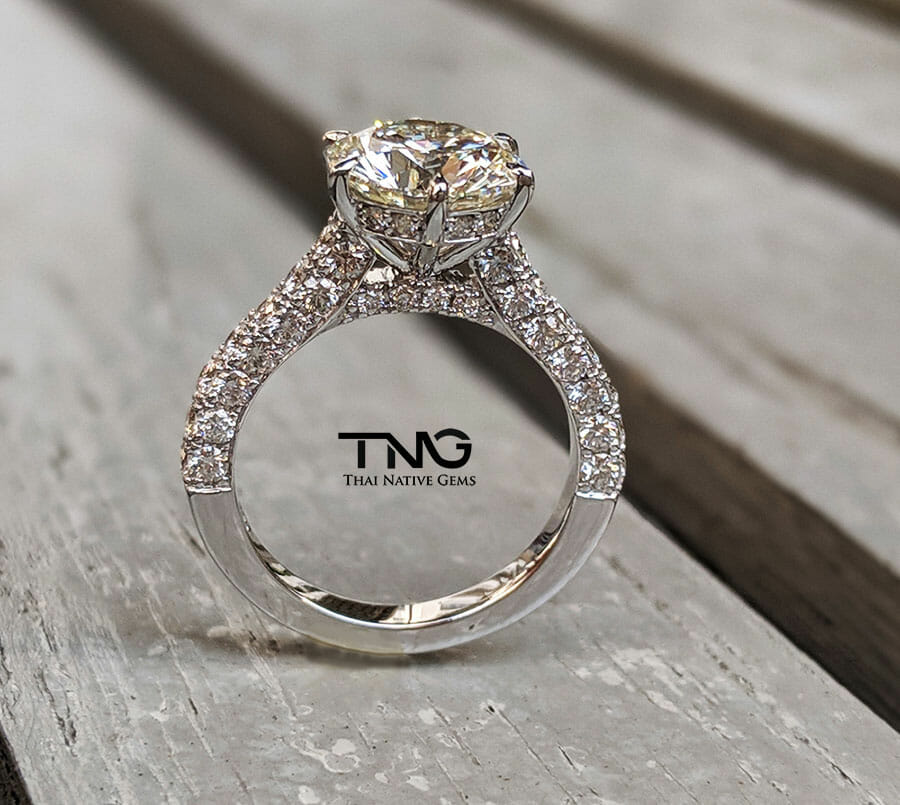
If you’re looking for the best diamond and a custom handmade engagement ring, contact us with your budget and what you have in mind. From there, we’ll email you four or five center-diamond options to choose from.
I’m not trying to sell you anything. The advice you’ll get is honest, frank, and objective: what I think is genuinely best within your budget. The service is free, with no obligation to buy. If none of the options suit, simply don’t reply, and you won’t hear from us again. You have nothing to lose.
Here’s how we find your stone:
- First, we check our local network of 50+ contacts in Bangkok for stones that fit your requirements.
- If nothing’s right, we search our global network of 900,000+ diamonds to find the best match. A stone sourced this way typically takes one to two weeks to reach Bangkok.
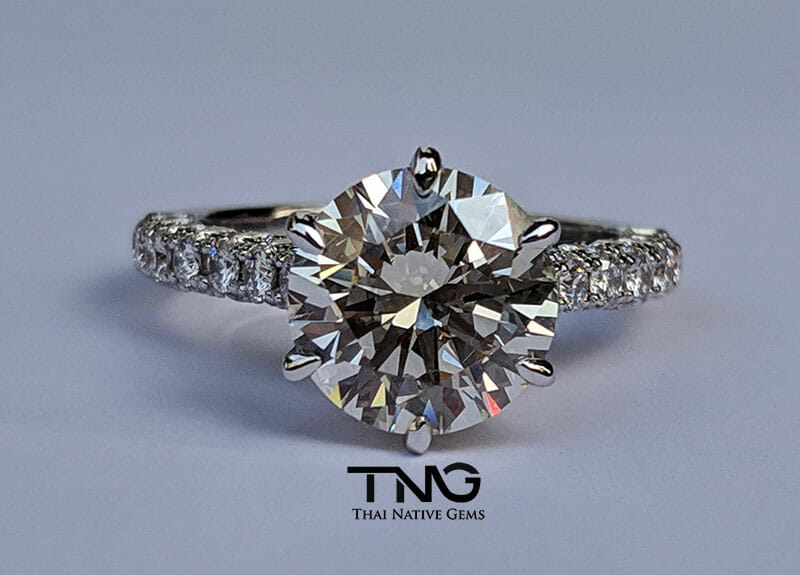
Every stone we handle is verified in-house by a GIA Graduate Gemologist or independently certified. Our rings are hand-crafted by highly skilled Thai craftsmen in 18k yellow or white gold, or 950 platinum, with a CAD design stage so you can refine the look before anything is made. Most rings are completed in about two to three weeks and shipped worldwide, insured, via FedEx.
Frequently Asked Questions
Is it cheaper to buy a diamond in Bangkok?
No. Diamonds are priced globally by the 4Cs, and Thailand adds 7% VAT. Where Bangkok genuinely saves you money is the craftsmanship: a custom setting costs far less here than in the West.
Is Bangkok a good place to buy an engagement ring?
Yes, provided you vet your jeweler properly. Its real strength is custom work: world-class bench skills at local labor rates.
Do you pay tax on diamonds in Thailand?
Yes. Diamonds are subject to 7% VAT, which can add a significant amount to a high-value purchase.
Are lab-grown engagement rings available in Bangkok?
Yes, and they’re increasingly popular. Look for an IGI or GIA report with a laser inscription, just as you would with a natural stone.
How long does a custom engagement ring take to make?
Usually around two to three weeks once the stone and design are finalized. Allow an extra one to two weeks if the diamond is being sourced from the global market.
Can you ship an engagement ring internationally from Bangkok?
Yes, typically insured via FedEx. Remember to check your own country’s import duties before it arrives.
What certificate should the diamond have?
A natural diamond should carry a GIA or HRD report; a lab-grown diamond an IGI or GIA report. Avoid stones certified only by unknown labs, or with no certificate at all.
Ordering an engagement ring online hasn’t ever been so easy since you will get honestly thousands, or else many online jewelers displaying their very own gemstone mags web based. Looking for wedding rings on the internet is simple and fast and you can get great affordable if you shop carefully.
Agree John,
However, in Bangkok there is still deficit of “reliable” or “reasonable” websites which offer this good online services! There are also people who still prefer buying a diamond engagement ring traditionally! As you know the main thing when buying any diamond or engagement online is the “trust” factor… Thanks for the comment!
It’s actualy a great blog thanks for it!
There are various jewellery stores located at different places. You need to explore them and do research to find the trusted store. The user reviews are helpful in this.
good to see and read a site that offers very useful information in searching and buying a diamond engagement ring, my search continues but now with more knowledge and understanding in the process of not getting ripped off
I live in Cha-am,
where can I buy weddingrings in Thaigold srious
???
Thank you very much for helping.
kindly regards
Dr. RAINER Sauer
Good Design i see and read a site that offers very useful information
Thanks for the useful information. I will email you the specification which I’m looking for.